The Steady Hands board
99 Positive Affirmations for Work You'd Actually Say Out Loud
Press play on twenty-two futures built for every working day. The chapters below take on feeling like a fraud and getting it wrong.
The daily cut, in order
“This board is the plain truth about who I am at work. Every future here is something I could say out loud without flinching. Nothing here is a performance for anybody else.”
Chapter 02
I Am Affirmations for Work
What you are worth before anyone checks your title or your output.
Chapter 03
Affirmations for Imposter Syndrome at Work
For the room where everyone sounds more certain than you.
Chapter 04
Affirmations for Coworkers and Work Relationships
For the week somebody talked over you twice.
Chapter 05
Affirmations for Work Stress and Anxiety
For the weeks that are too much. If the load is heavier than a hard stretch, these futures are not the help you need first.
Chapter 06
Affirmations for Mistakes and Criticism at Work
For the mistake you are still replaying at eleven at night.
Chapter 07
Affirmations for a New Job and What's Next
For the Sunday you spent reading job listings.
Chapter 08
Affirmations for Career Growth and Promotion
For the day you decide to stop waiting to be noticed.
Take one with you


set one as your lock screen. see it 100 times a day. free for personal use.
Keep the whole board
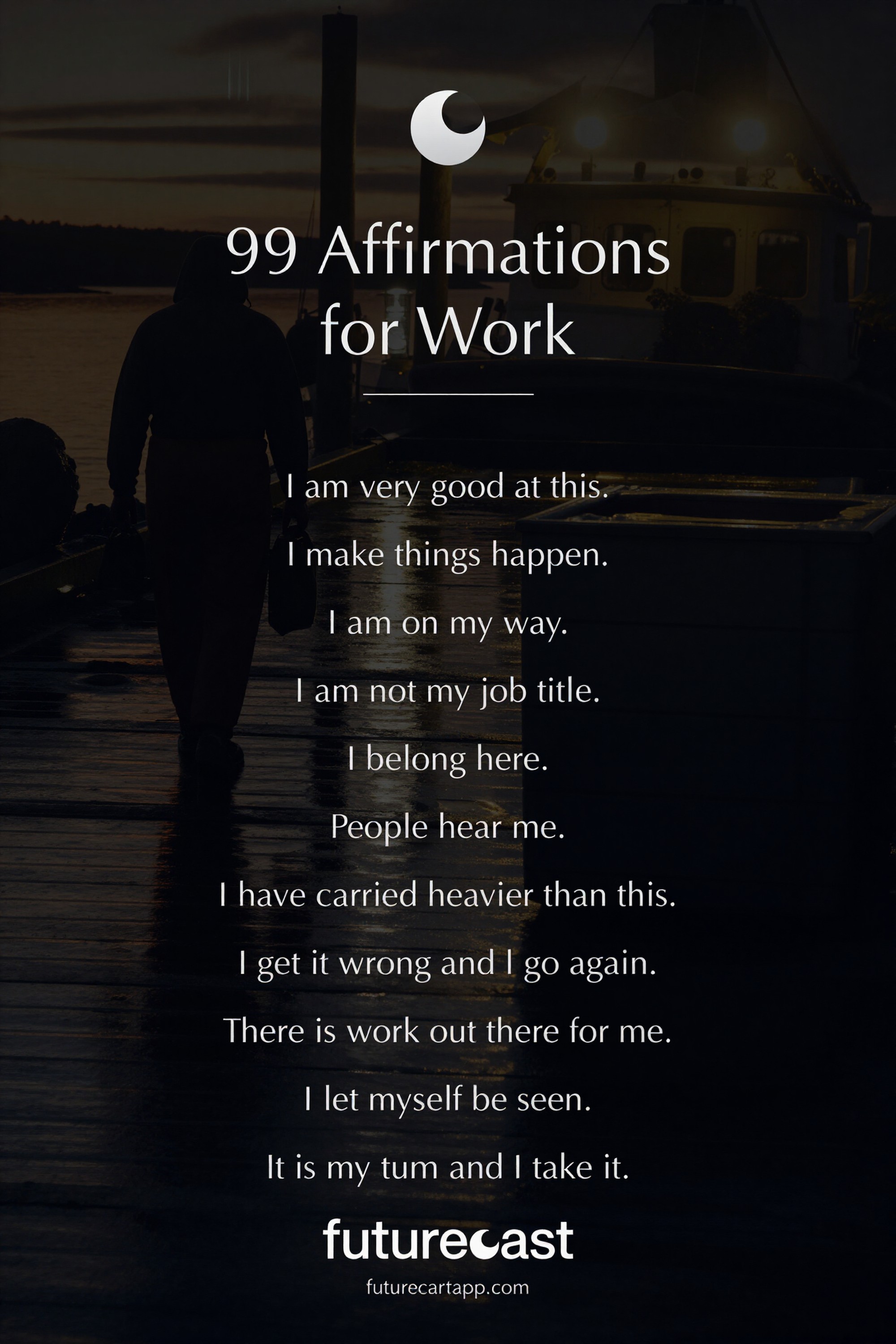
All 99 futures, two ways. One for your wall or your phone, one for paper.
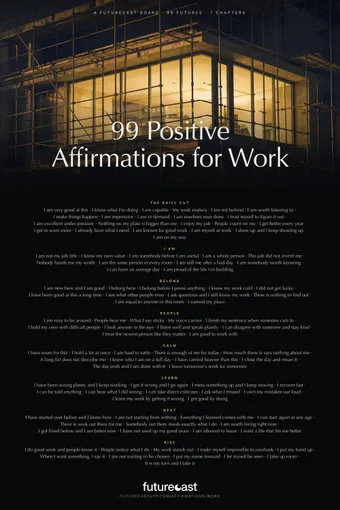
The poster
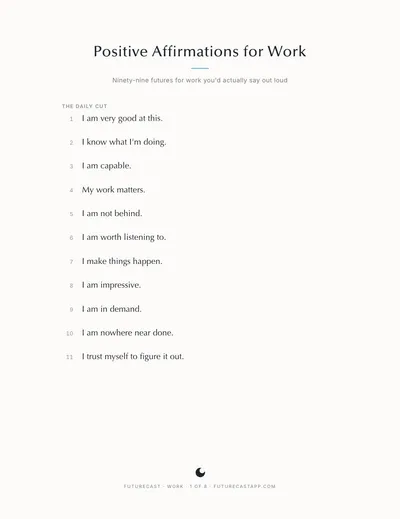
What are positive affirmations for work?
Positive affirmations for work are short first-person statements, said in the present tense, that you repeat until they sound like fact instead of a pep talk. Said daily, they change what you assume about yourself before the workday starts. This board covers self-worth, feeling like a fraud, the people around you, pressure, getting it wrong, what comes next, and being seen. Nothing here promises you a job, a raise, or a promotion. In Futurecast they become futures.
How to practice this board
Start with two or three futures, not all ninety-nine. The daily cut of twenty-two is what you say every working day, and the seven chapters are for the days a specific thing is hard. Say them out loud, once through, in a gap the day already has: the drive in, the walk from the car, the last quiet minute before you open anything. Out loud matters, because reading a sentence and hearing yourself say it are not the same event. In Futurecast, each line becomes a future: a statement recorded in your own voice that plays back while your hands are busy.
Then go where it stings. Belong is for the room where everyone sounds more certain than you. People is for the week somebody talked over you twice. Learn is for the mistake you are still replaying at eleven at night. Next is for the Sunday you spent reading job listings. Whichever chapter you just decided was not for you, start there.
Why these sound different
Most lists of work affirmations are written for somebody other than you. Managers hand some of them out: I am a valuable asset, I contribute meaningfully to my team. They could come straight off a self-assessment form. People promising you a promotion in thirty days wrote the rest.
These ninety-nine are written for the person who has to go in tomorrow and still be themselves. Some are absolutes that refuse to argue: I am very good at this. I am not behind. A future like that does not wait for proof. It resets what you let yourself assume before anyone has spoken. The rest are plain: what you know, what you can carry, what you stopped apologizing for.
What this board will not tell you
It will not tell you that you are going to get the job, the raise, or the apology. Nobody writing a list knows that, and a future that promises it is the fastest way to make the whole practice feel like a lie. It will not tell you that a bad workplace is your attitude problem either. Some rooms really are wrong, and no sentence you repeat in the car is going to fix one. What these futures change is what you bring in with you and what you carry back out.
What to expect, honestly
The first week usually feels like lying, and that is normal. You are saying sentences you currently disagree with, and the disagreement has years of practice behind it. Keep going anyway. Speed changes before belief does. The gap between something landing badly and you deciding what it means gets shorter. You notice it in a meeting, or in a message you do not answer the way you used to, or on the drive home when the replay does not start. Nothing mystical happened. You rehearsed a response often enough that it arrived before the old one did.
On the web, it's our voice.In Futurecast, it's yours.
Record every future on this board in your own voice. Then see yourself living it, in visions made from your photos.
Get the app